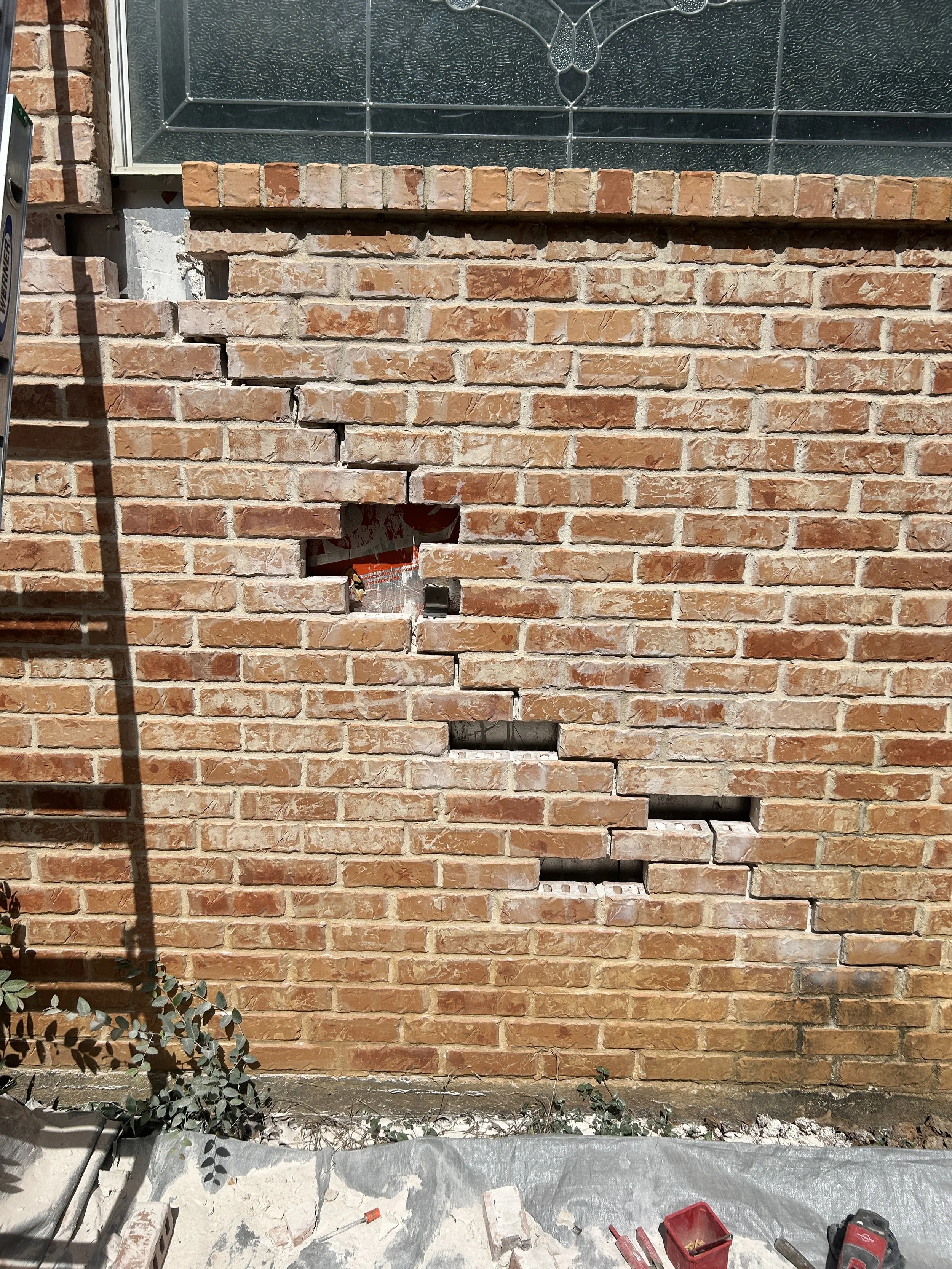
BRICK CRACK REPAIR GUIDE
Stair-Step Cracks in Brick: What Do They Mean?
Stair-step cracks follow the mortar joints between bricks, creating a stepped pattern through the wall. They can develop from several different conditions, including movement around openings, foundation movement, inadequate masonry support, expansion and contraction, or changes in the structure behind the brick. This guide explains what the crack pattern can tell you, which warning signs matter, and why the right repair starts with identifying what caused the movement.
UNDERSTANDING THE CRACK PATTERN
What Is a Stair-Step Crack?
A stair-step crack follows the mortar joints between bricks instead of cutting straight through the wall. The crack typically moves horizontally through one mortar joint, then vertically through a head joint, creating a stepped pattern across the masonry.
This pattern usually means the brick veneer has moved enough for the mortar joints to separate along the weakest path. The important question is not just what the crack looks like, but where it starts, where it travels, and what part of the wall is moving around it.
Some stair-step cracks are relatively minor and develop from normal movement or expansion. Others can point to foundation movement, inadequate support around an opening, movement at a roofline, or another structural condition affecting the masonry.
The crack pattern is a clue. The location and cause of the movement determine what repair is actually needed.
CRACK LOCATION MATTERS
What Different Stair-Step Crack Locations Can Mean
The shape of a stair-step crack matters, but its location often tells us even more. Where the crack begins, what it runs toward, and what is located behind or below that area can help narrow down what is causing the masonry to move.
Near Windows or Doors
Stair-step cracking near an opening can develop when the masonry above or beside the opening begins to move. The condition may involve the lintel, inadequate bearing, movement in the surrounding wall, or changes in the structure supporting the brick.
At Building Corners
Cracking that begins near a corner and travels diagonally through the mortar joints can be associated with differential movement between portions of the wall, foundation movement, or stress concentrated at the corner of the structure.
Along the Lower Portion of a Wall
Stair-step cracking closer to the foundation can indicate that the brick veneer is responding to movement below it. The direction of the crack, nearby openings, and whether the wall has shifted or separated all matter when determining the cause.
At Rooflines or Wall Transitions
Cracks near rooflines, step-downs, or transitions in the wall can develop where different parts of the structure move independently. Support and attachment conditions behind the masonry should be considered when the cracking repeatedly develops in these areas.
WHY THE WALL IS MOVING
Common Causes of Stair-Step Cracks in Brick
Stair-step cracking is a symptom of movement, not a diagnosis by itself. Several different conditions can create a similar crack pattern, which is why the surrounding wall, nearby openings, support conditions, and direction of movement all need to be considered before deciding how the masonry should be repaired.
Foundation or Structural Movement
When one portion of the structure moves differently from another, the brick veneer can be forced to accommodate that movement. Because mortar joints are typically weaker than the brick itself, the separation often follows those joints and forms a stair-step pattern.
Movement Around Windows and Doors
Openings interrupt the continuity of a brick wall and concentrate loads around the corners. If the lintel, bearing, surrounding masonry, or structure behind the opening begins to move, cracking can travel outward from the window or door through the mortar joints.
Rooflines and Wall Transitions
Areas where rooflines, wall heights, or structural systems change can experience movement differently from the masonry around them. In some conditions, inadequate support or attachment behind the brick can allow repeated movement and cracking to develop near these transitions.
Expansion and Contraction
Brick masonry naturally expands and contracts as temperature and moisture conditions change. When the wall does not have enough room to accommodate that movement, stress can build in the veneer and eventually release through the mortar joints.
REPAIR THE CAUSE — NOT JUST THE CRACK
Why Repointing a Stair-Step Crack May Not Solve the Problem
Repointing can restore deteriorated mortar joints and improve the appearance of a wall, but it does not stop structural movement. If the brick is still being pushed, pulled, or allowed to move because of an unresolved condition behind it, the repaired joints can crack again.
Stable Masonry With Localized Mortar Damage
If the wall is stable and the cracking is limited to deteriorated or previously damaged mortar joints, carefully removing the failed mortar and repointing the joints may be an appropriate repair.
- No continuing displacement
- No sagging or separation
- No failed support condition
- No evidence the crack is actively widening
Cracking Caused by Continued Movement
When the crack developed because the masonry or the structure supporting it has moved, repointing only treats the visible symptom. The source of that movement needs to be identified and corrected before the masonry repair can be expected to remain stable.
- Brick has shifted or separated
- Crack continues to reopen
- Movement is concentrated around an opening
- Support, bearing, or attachment is inadequate
CORRECTING THE SOURCE OF MOVEMENT
What Proper Stair-Step Crack Repair Involves
The correct repair depends on what caused the wall to move. A lasting repair starts by identifying whether the cracking is coming from the masonry itself, an opening, inadequate support, movement behind the veneer, or another structural condition. Once the source is understood, the wall can be repaired around the actual cause instead of simply filling the crack.